I Don’t Want To Anymore”: How We Protect Motivation and Help Children Find Their Path
For children affected by war, emotional resources are often very fragile.
When a child says, “I don’t want to study anymore,” we do not pressure or force them. Instead, we activate our support approach to understand what may be causing the struggle.
Our support process in these situations:
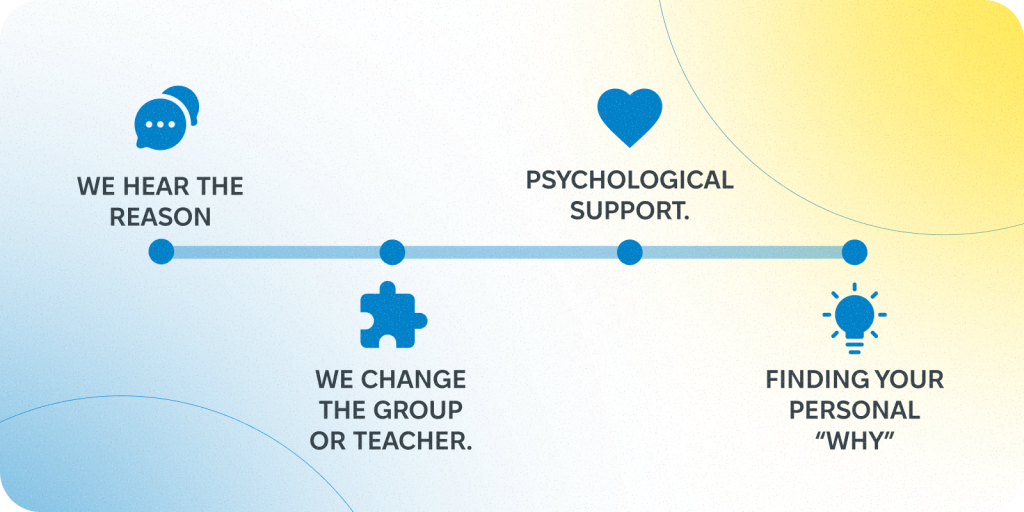
1. Dialogue and understanding the reason
First, we speak with both the child and the parents.
Very often, the reason is hidden in everyday challenges: changes in school schedules, emotional exhaustion, academic overload, or technical difficulties.
Understanding the cause is already half of the solution.
2. Flexibility and finding the “right” teacher
Every child is unique – just like our 30 study groups.
Each teacher has their own teaching style, methodology and energy.
If a child feels uncomfortable or disconnected in one group, we offer another option.
We want every child to find a learning environment where they feel safe, understood and free to grow.
3. Psychological support
We understand that the loss of motivation is often not about English itself.
Sometimes it reflects emotional burnout, anxiety, or depressive states caused by the realities of war.
In such cases, we offer professional psychological support to help stabilize the child’s emotional wellbeing.
4. Finding a personal “why”
We help children reconnect learning with personal interest and meaning.
For some, it is understanding the lyrics of a favorite song.
For others, it is games, creativity, or simply the opportunity to talk with peers about what they are going through.
We fight for every one of our 251 students.
For us, education is not only about completing a curriculum – it is about protecting the spark of curiosity in a child’s eyes, even when the world around them feels dark.