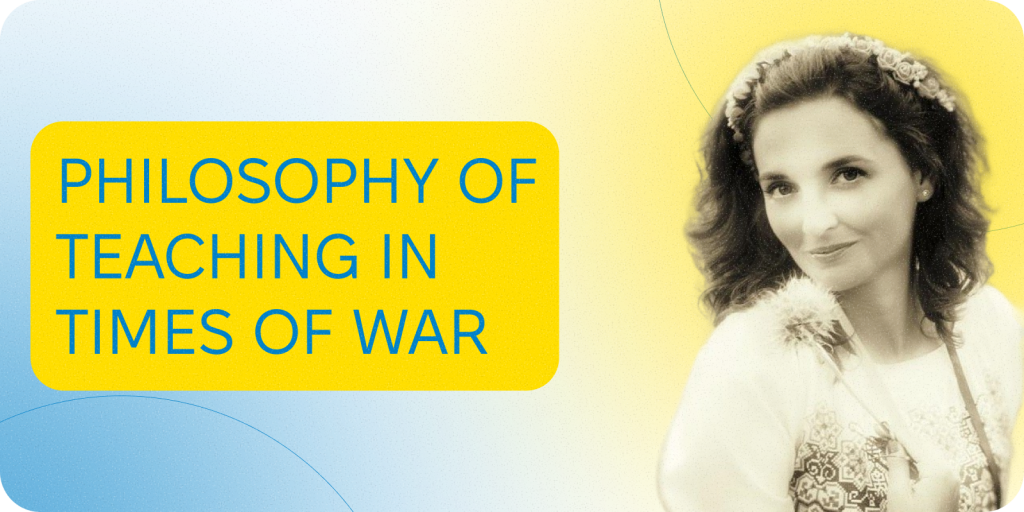
Teaching philosophy in times of war: How to educate when air raid sirens become part of everyday life
During wartime, the role of a teacher extends far beyond textbooks and grammar rules. For many children, an online lesson is not only a place to learn but also a space for stability, support, and emotional safety.
For Yevheniia, an English teacher at Hope – children of Ukraine, today’s students are learning much more than a foreign language. Every day, they are learning resilience.
A classroom as a safe space
At first glance, modern students may seem no different from those we taught before the war. They come to class with different moods, enjoy some activities more than others, celebrate successes and face challenges along the way.
Yet the war has changed all of us.
“After spending a night under missile attacks, when your house shakes from explosions and you hold your child close, you begin to see your students differently. I know their parents are comforting them too, trying to help them feel safe. That is why I want my students to smile during lessons, to feel free from fear, and to understand that making mistakes is a natural part of learning.”
For Yevheniia, every lesson begins not with grammar but with a simple question:
“How are you today?”
Giving children space to share their feelings has become just as important as teaching vocabulary and grammar.
Educational resilience matters more than grades
At Hope – children of Ukraine, we often talk not only about educational achievement but also about educational resilience.
For Yevheniia, this concept has a very practical meaning.
“If a child joins a lesson after a sleepless night, despite power outages, air raid alerts or difficult circumstances, they are already a hero. I tell my students this often. Ukrainian children are facing challenges no child should ever have to experience.”
Today, resilience means continuing to learn despite uncertainty, maintaining curiosity and finding the strength to keep moving forward.
Mistakes are signs of growth
One of the core principles of Yevheniia’s teaching philosophy is creating an environment where children are not afraid to make mistakes.
“How can anyone learn a language without making mistakes? The more mistakes we discover, the more opportunities we have to learn.”
Instead of fearing grades, students receive encouragement, guidance and support. Every mistake becomes another step toward confidence and fluency.
At the foundation, there is no pressure to rush through a textbook. If a topic requires more time, teachers spend as much time as necessary to ensure every child fully understands the material.
“Take a breath”: teaching children under stress
Stress has become a constant part of life for many Ukrainian children. Yet learning can still thrive in these circumstances.
“To start speaking English, a child must not be afraid. They need to know that someone will listen, help them, suggest a word when needed, and patiently wait for them to finish their thought. Very often during lessons, I simply say, ‘Take a breath.’”
This approach goes beyond language learning. It is about respect, patience and belief in every child’s potential.
Learning through a screen without feeling distant
Online learning has become the norm for many Ukrainian children. However, physical distance does not have to mean emotional distance.
Power outages, unstable internet connections, and security concerns sometimes make it impossible for students – or teachers – to turn on their cameras. Yet meaningful connections can still be built.
“We work as a team. If one student gets stuck or forgets a word, another helps. We support one another. That creates an atmosphere where no child feels alone.”
Sometimes learning itself takes a temporary pause.
If a child needs to share a story, talk about their experiences, or simply express their emotions, there is always room for that conversation.
“We can stop, talk, laugh, support one another, and then continue the lesson. English isn’t going anywhere.”
More than English
For Yevheniia, the most important outcome is not only language proficiency.
She hopes her students will grow into confident, courageous and compassionate individuals.
“I teach children not to be afraid. Not to be afraid of making mistakes, expressing their opinions, trying something new, or supporting others. I see them becoming future leaders – not only in Ukraine but around the world.”
She believes that children who continue learning despite war are developing a unique strength that will help shape the future.
“The war will end. But the knowledge, resilience, and self-confidence these children gain will stay with them forever. Our children are Ukraine’s future and I truly believe they will achieve extraordinary things.”